Friday, August 25, 2006

Starting School


My oldest granddaughter started kindergarten on Monday. I talked with her on the phone at the end of the day and asked how she liked the first day of school. She said, "It was a really long day." She has the privilege of attending an all-day kindergarten where they live in California. Compared to her 2 1/2 hour preschool last year, I am sure it seemed like a long day. My hope is that her teacher can provide engaging activities that will make the long day into an incredible day of learning. I have been in half-day kindergarten classes that are about as exciting as watching cement harden. I can't imagine what they would be like with twice as much time. The hours of kindergarten are so important and the children are so precious that it is essential kindergarten teachers keep the children engaged and excited about learning. That is my hope for my granddaughter. I guess I will be able to tell when I ask her in a few weeks about kindergarten. If she says, "It's a really long day," I will begin to worry.

Wednesday, August 16, 2006

Childhood Obesity


We definitely have an obesity epidemic in our country. I recently researched the topic for a presentation and was sad to learn that close to 10% of our preschool children are overweight. When children are overweight they have an 80% chance to be an obese adult. There is a list of culprits, but the main dangers are high-fat foods and lack of physical activity. It doesn't help that many school systems have recently cut physical activity from the school day. Add to that high-fat school meals and it is a recipe for an obese child. We need to be more responsible than that. The first thing I have done is get rid of any high fat/sugar treats for my grandchildren. Now we have healthy treats at my house and we try to be outside doing activities more often. I want them to be healthy adults.

Saturday, August 5, 2006

Collaboration

I recently attended some early childhood meetings in California. As part of a retreat with an early childhood organization, one of the main issues discussed was making efforts to collaborate with other agencies providing early childhood services. I hear that around the country quite often. It seems to be difficult for some agencies to collaborate services for young children. It is disturbing because as long as multiple agencies are providing early childhood services, we will need to collaborate and do what is best for children. As long as the players have the attitude that, "We provide much better service and know what we are doing," we will never have true collaboration. I challenge all the key players to do what is best for children, not their individual egos. Having said that, I applaud the areas of the country that seem to have seamless services and collaboration. Unfortunately, those are the exceptions not the rule.

Saturday, July 29, 2006

Fine Motor Questions


Lisa's comments on my last post are very true. PreK-K teachers are so worried about meeting objectives right now that they forget how critical the fine motor development is for children. Good teachers realize that you can do both. There are many preschool and kindergarten standards that can be addressed using fine motor development activities. In Lisa's situation as a first grade teacher, I would suggest some of the following activities, even in first grade.
1. I would still acquire some large pencils and crayons. Have the first graders do some of their writing activities with the larger instruments. It is not a step back! It will just reinforce those fine motor skills.
2. Have the children form the letters of the alphabet out of clay, play dough or even wet sand. This is a great cognitive training as well as a wonderful fine motor reinforcement.
3. Allow the children to write with their pointing fingers in a shallow cookie sheet filled with a thin layer or salt or sand. You could also use the old colored hair gel in a ziplock bag approach, as well. Mark the tray or bag in the top left corner to indicate which direction the child should write.
There are other fine motor suggestions that I could cover. If you want additional ideas, please email me at jfunk@excelligencemail.com and I will be happy to share.

Wednesday, July 26, 2006

Building the Foundation


We are getting a new kitchen today. The kitchen was entirely gutted and now workmen are busily putting in new cabinets. I was interested in the fact that they put in foundation pieces (called "toekicks," I think?) before installing the cabinets. I was struck by how similar this is to a child's education. Early Childhood years are a very critical piece for building a solid foundation for learning. It is usually the foundation pieces that confuse people into thinking children are "just playing." The better the foundation, the stronger the structure.

Tuesday, July 18, 2006

Dramatic Play


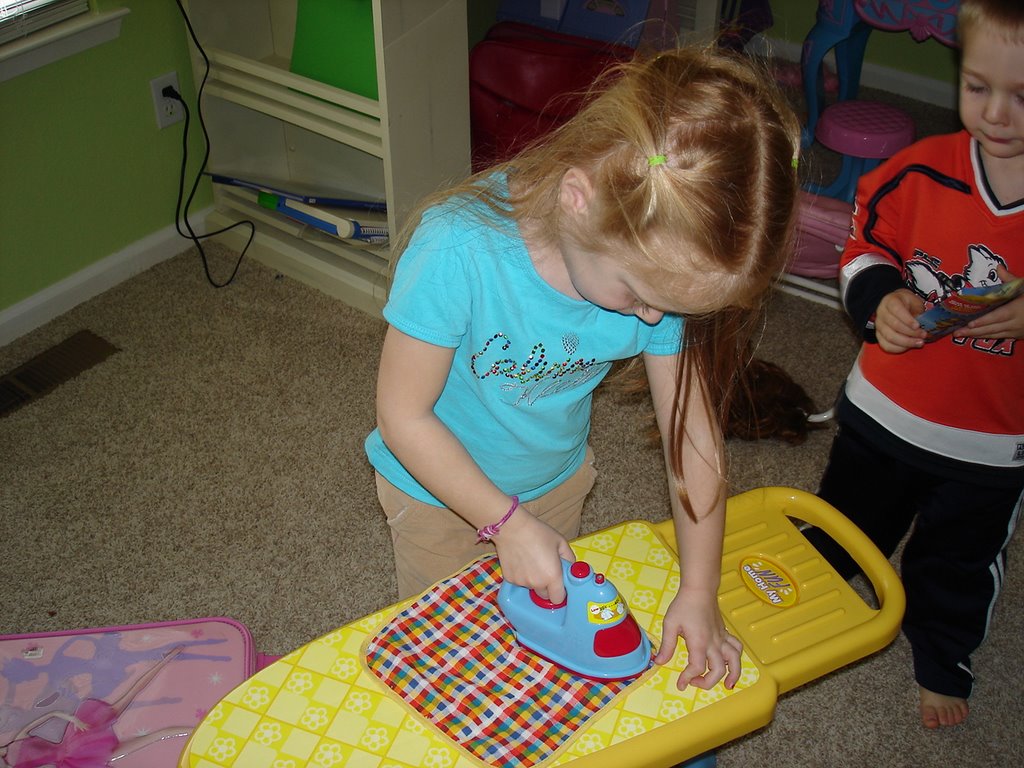
If you take a few moments to observe most early childhood children, it is evident that dramatic play is critical. Children love to act like they are someone/something else. I was watching my three-year-old friend the other day put a princess dress over her clothes. She is convinced that she is a princess. I remember my kindergarten students becoming so involved in acting out a dramatic play activity. We hear complaints all the time that children are watching too much television and playing video or computer games. Dramatic play can be an effective way to get children to do something active and exercise creativity and imagination. Children who are allowed to engage in dramatic play activities are more prepared emotionally and mentally for life's changes.

Tuesday, July 11, 2006

Family Field Trips


This is the time of year when many families and groups take small vacations or driving trips. For preschool children, these trips can be long and uninteresting. One thing parents can do is work on the child's basic skills while traveling. Have the child find alphabet letters on signs, both street and billboard signs. If the child knows the alphabet letters, have him/her count how many "A" letters are found (or any other letter of choice). This will provide help in recognizing letters and also in counting. Another fun activity is to remember and recite as many nursery rhymes as possible. This is a great reinforcement for phonemic awareness, which is essential for early reading skills. Make the trip fun!